



Abstract
Background
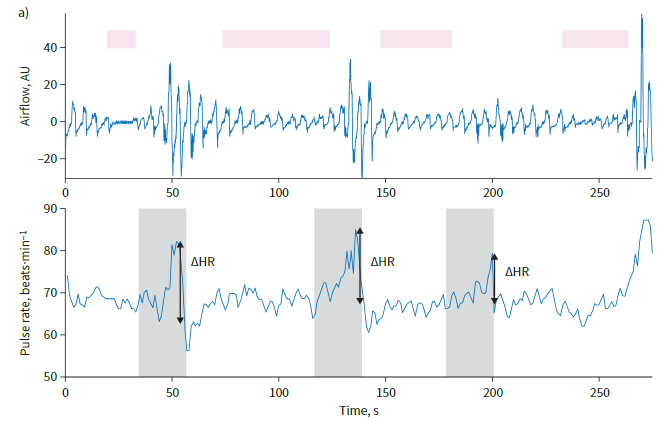
Sleep apnoea-specific heart rate response (?HR) has been identified as a promising biomarker for stratifying cardiovascular (CV) risk and predicting positive airway pressure (PAP) benefit in obstructive sleep apnoea (OSA). However, the need for prior manual scoring of respiratory events potentially limits the accessibility and reproducibility of ?HR. We aimed to evaluate the association of pulse rate response to oxygen desaturations automatically derived from pulse oximetry (?HRoxi) with CV risk in OSA.
Methods
?HRoxi and ?HR were measured in OSA patients from the Institut de Recherche en Santé Respiratoire Pays de la Loire Sleep Cohort (PLSC; n=5002) and the HypnoLaus cohort (n=1307). The primary outcome was major adverse CV events (MACEs), a composite of mortality, stroke and cardiac diseases. Cox regression analyses were conducted to evaluate the association of ?HRoxi and ?HR, categorised into low, midrange and high categories, with MACEs.
Results
MACEs occurred in 768 patients from PLSC and 87 patients from HypnoLaus (median follow-up 8.0 and 7.5?years, respectively). Multivariable Cox models showed that subjects with high ?HRoxi (versus midrange) had higher risk of MACEs in PLSC (hazard ratio (HR) 1.42, 95% CI 1.18–1.71) and HypnoLaus (HR 1.72, 95% CI 1.03–2.87). Similar findings were observed for high ?HR. Among 2718 patients from PLSC treated with PAP, the association of PAP adherence (PAP use ?4?h·night?1 versus non-adherent) with MACEs was modified by baseline ?HR and ?HRoxi (pinteraction<0.05).
Conclusion
?HRoxi could constitute a reliable and easy to measure biomarker for stratifying CV risk and predicting CV benefit of PAP in OSA.