




Abstract
Background
Prostasin is expressed in the lung epithelium where it regulates fluid and electrolyte balance via sodium channel proteolysis. We investigated whether circulating prostasin levels are associated with the presence and severity of idiopathic pulmonary fibrosis (IPF) and whether prostasin levels, or changes in them, are associated with mortality.
Methods
Patients with IPF came from the IPF-PRO Registry. Controls without lung disease had a similar age/sex distribution. Prostasin was quantified in plasma taken at enrolment and, in the IPF cohort, ∼6 months post-enrolment, by immunoassay. Linear regression was used to compare prostasin levels at enrolment in patients with IPF versus controls and, in the IPF cohort, determine associations between prostasin level and lung function. Multivariable Cox proportional hazards models determined associations between prostasin level at enrolment and change in prostasin level over 6 months and respiratory death.
Results
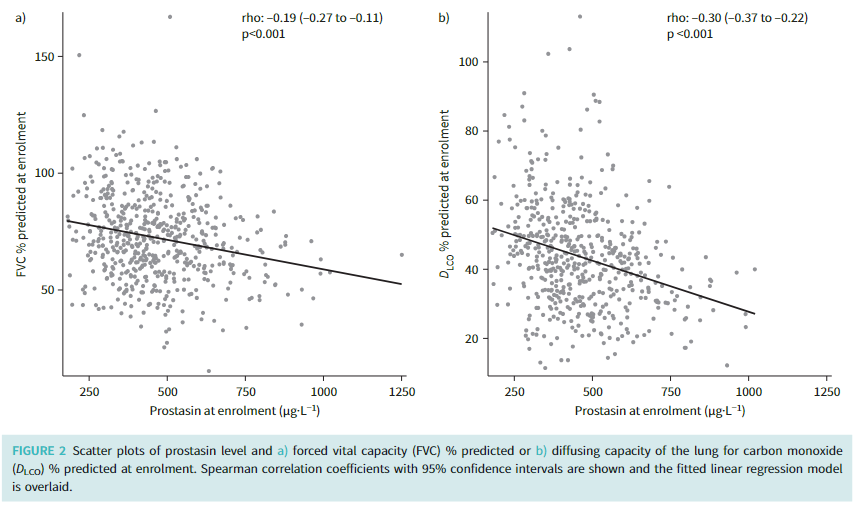
Prostasin level at enrolment was higher in patients with IPF (n=624) versus controls (n=100) (fold-difference 1.75; p<0.001). In the IPF cohort, the difference in disease severity per 1 standard deviation (sd) difference in prostasin was −3.85 for forced vital capacity % predicted and −4.24 for diffusing capacity of the lung for carbon monoxide % predicted (both p<0.001). The adjusted hazard ratio (HR) for respiratory death per 1 sd difference in prostasin at enrolment was 1.20 (95% CI 1.04–1.40, p=0.014, n=624). The adjusted HR for subsequent respiratory death per 1 sd difference in change in prostasin over 6 months was 1.33 (95% CI 1.01–1.74, p=0.041, n=290).
Conclusions
Circulating prostasin is an independent marker of mortality risk in patients with IPF.