



Abstract
Background
Social support (SS) may contribute to the long-term recovery of critical illness survivors. This study focuses on survivors of acute respiratory distress syndrome (ARDS) to investigate the causal relationship between SS and health-related quality of life (HRQoL) and healthcare utilisation in critically ill patients.
Methods
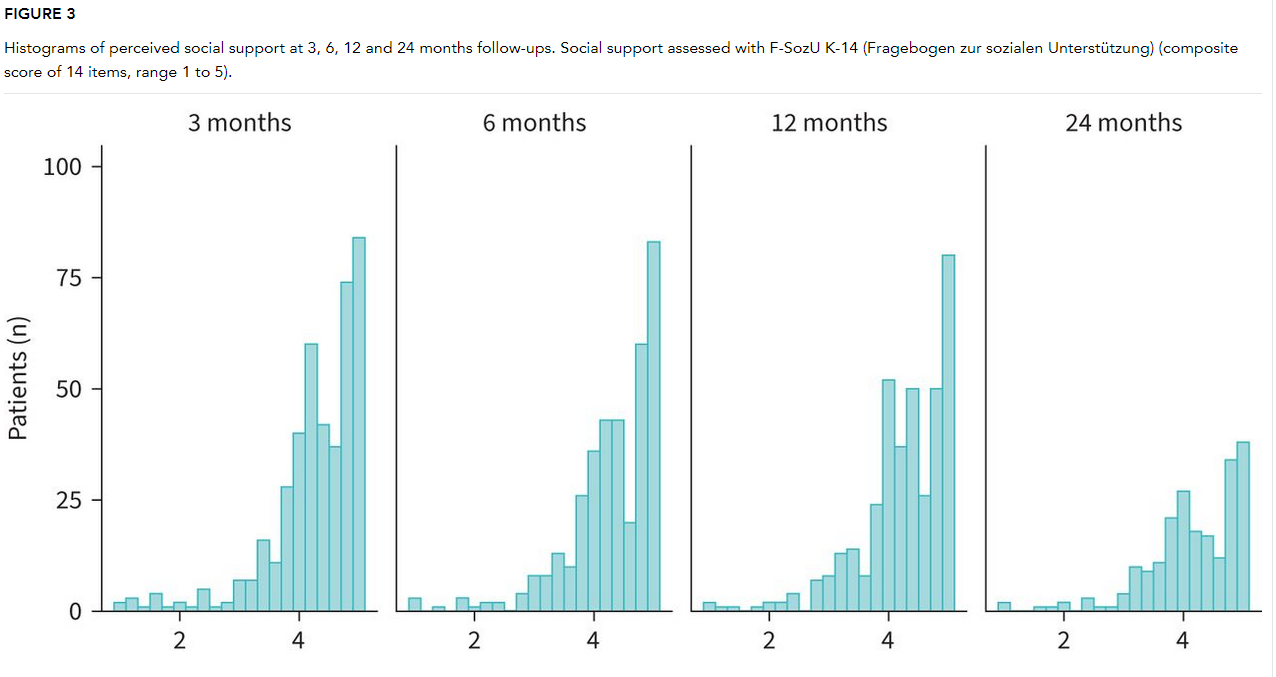
A cohort study with 877 ARDS survivors in 61 intensive care units (ICUs) was conducted in Germany between 2014 and 2019. SS was measured using the F-SozU K-14 (Fragebogen zur sozialen Unterstützung) scale and HRQoL was assessed using the Physical and Mental Component Summaries of Short Form-12 at 3, 6, 12 and 24 months after ICU discharge. Healthcare utilisation was assessed after 12 and 24 months. To identify confounders and allow for causal inferences, a directed acyclic graph was developed.
Results
Adjusted regression models demonstrated significant positive impact of SS on mental HRQoL after 3 months onward (all β values >0.15, all p-values <0.05). This influence increases over time. In contrast, the influence of SS on physical HRQoL and healthcare utilisation remained inconclusive (only one significant association for physical HRQoL at 12 months: β=0.128, p<0.05, otherwise all p-values >0.05).
Conclusion
Results indicate SS plays an important and unique role in the long-term recovery of survivors of critical illness in terms of mental health. It appears that the more distal mechanism of SS unfolds progressively over time, perhaps as the immediate sequelae of critical illness after discharge subside. In contrast, SS does not appear to exert a substantial causal impact on physical HRQoL and healthcare utilisation.