



Abstract
Background
Allograft injury in the early post-transplant period is a known risk factor of death after lung transplantation. However, the recipient tissue injury profile and its association with outcomes remain unexplored. This study leverages cell-free DNA (cfDNA) to test this association.
Methods
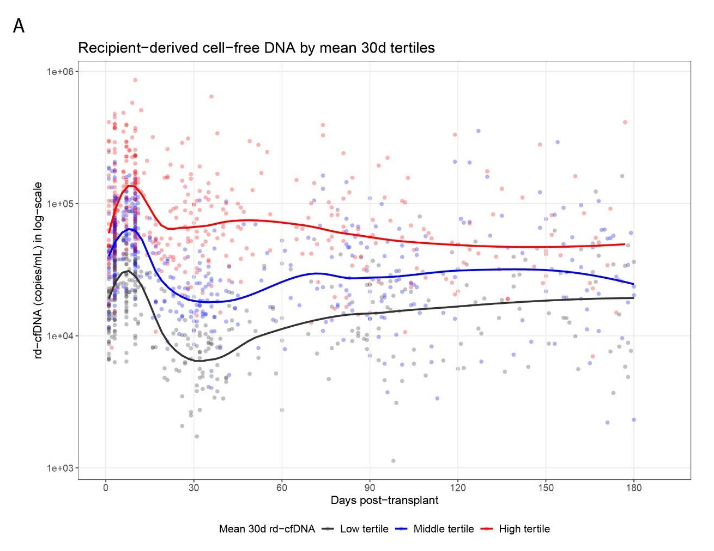
The prospective cohort multicenter study included lung transplant recipients (GRAfT, NCT02423070) with serial plasma measurements of recipient-derived (rd)-cfDNA using digital droplet PCR. Non-transplant healthy controls were recruited as the comparator. Whole-genome bisulfite sequencing identified tissue sources of cfDNA. Mean rd-cfDNA levels within 30 days post-transplant was computed. Multivariable regression models were used to assess the association between rd-cfDNA tertiles and the primary outcome of death and secondary outcomes.
Results
The study included 215 patients with 2530 cfDNA values, including 675 cfDNA assessments in the first 30 days. Median rd-cfDNA levels in the first 30 days post-transplant were ∼16-fold higher than cfDNA for healthy controls. Patients in the highest tertile rd-cfDNA group had lower lung function post-transplant, and increased risk of death (HR: 3.15, 95% CI: 1.59–6.24, p<0.001) and acute rejection (HR 2.33, 95% CI: 1.33–4.08, p=0.03), compared to the low/middle tertile group. Tissue-specific cfDNA sources were also distinct cfDNA in the highest versus lowest rd-cfDNA tertiles, with cfDNA from innate immune cells serving as the strongest predictor of mortality.
Conclusion
Post-transplant recipient tissue injury varies between lung transplant patients and is associated with increased risk of acute rejection and mortality.