



Abstract
Background
Interest in bronchiectasis is increasing and no prior study has used Artificial Intelligence (AI) to interrogate its rich, multidimensional literature to characterize research trends, themes and knowledge gaps.
Methods
We reviewed original bronchiectasis research between 1949–2024 (75-year period) to identify, characterize and assess research trends and trajectories using two AI-powered approaches: (1) ATLAS, an AI-topic modelling tool and (2) a custom model, leveraging ChatGPT embedding and text-generation models.
Results
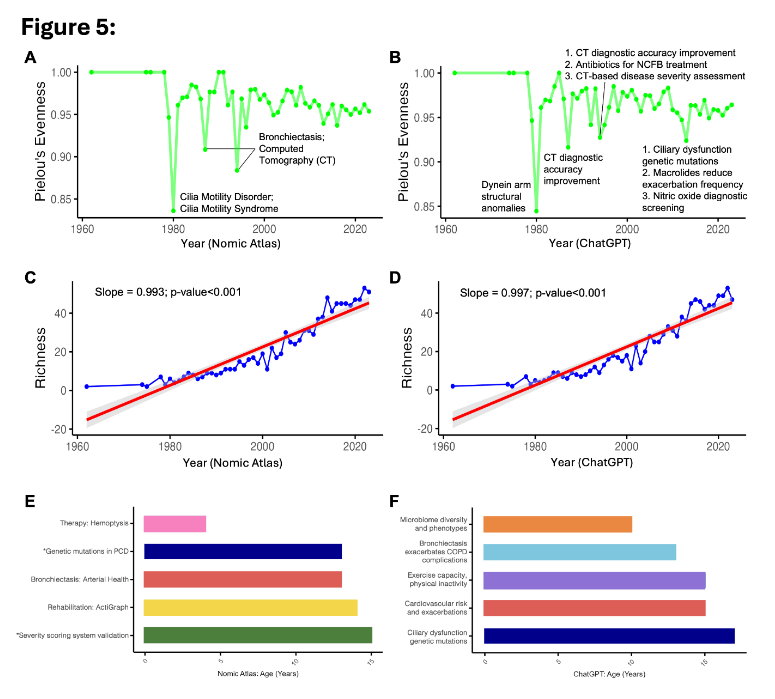
AI-powered analytics reveal a nine-fold increase in bronchiectasis research speed since 2000, typified by enhanced richness with four new research topics emerging every five years. Publication trends mirror clinical and technological advances, exemplified by significant rises in computed tomography (CT), microbiome and clinical studies following adoption of HRCT (1970s), next-generation sequencing (2005) and the first clinical guidelines (2008–2010). Topics with sustained growth (i.e. popular) include bronchiectasis-COPD overlap, microbiome-infection, cardiovascular health and exacerbations while those with sudden, short-term increased interest (i.e. trending) focused on microbial pathogens and primary ciliary dyskinesia (PCD) genetics. Mortality represents a nascent topic demonstrating highest year-on-year interest. Growth of research within the “vicious vortex” demonstrates thematic imbalance with few studies overlapping with non-vortex components. Evolving research focus toward inflammation is evident, with increased work on comorbidities and quality of life demonstrating a shift from disease- to patient-centric research.