



Abstract
Background
Predicting shorter life expectancy is crucial for prioritising antifibrotic therapy in fibrotic lung diseases (FLDs), where progression varies widely, from stability to rapid deterioration. This heterogeneity complicates treatment decisions, emphasising the need for reliable baseline measures. This study focuses on leveraging an artificial intelligence (AI) model to address heterogeneity in disease outcomes, focusing on mortality as the ultimate measure of disease trajectory.
Methods
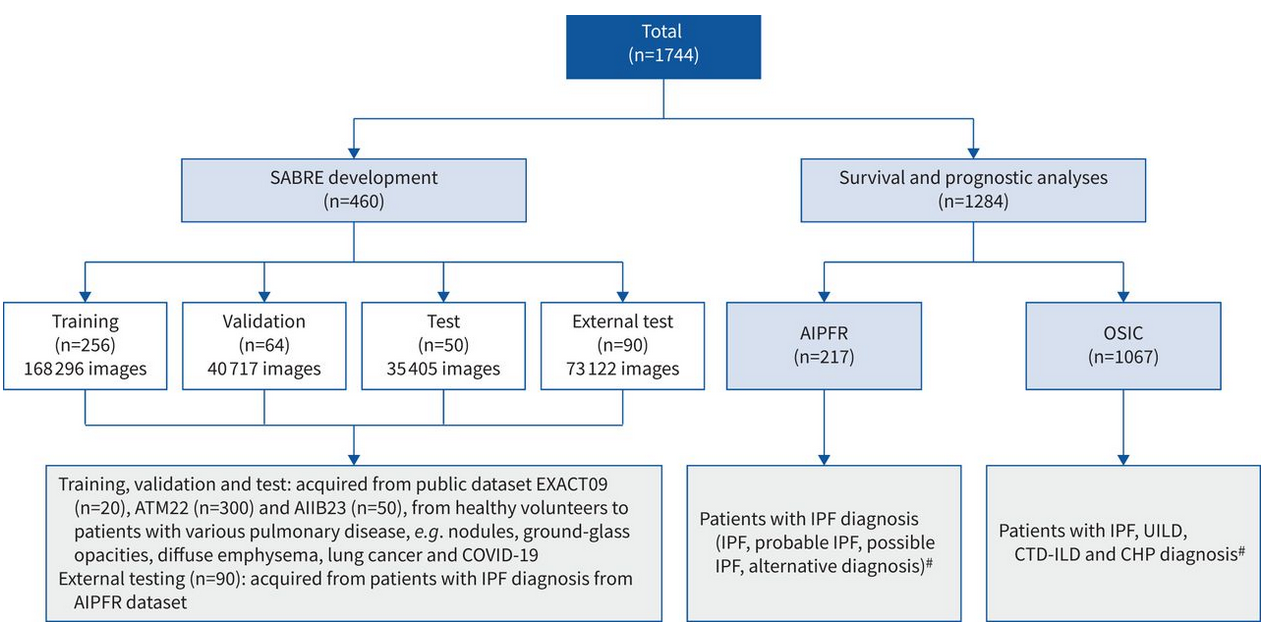
This retrospective study included 1744 anonymised patients who underwent high-resolution computed tomography (HRCT) scanning. The AI model, SABRE (Smart Airway Biomarker Recognition Engine), was developed using data from patients with various lung diseases (n=460, including lung cancer, pneumonia, emphysema and fibrosis). Then, 1284 HRCT scans with evidence of diffuse FLD from the Australian Idiopathic Pulmonary Fibrosis Registry and Open Source Imaging Consortium were used for clinical analyses. Airway branches were categorised and quantified by anatomical structures and volumes, followed by multivariable analysis to explore the associations between these categories and patients’ progression and mortality, adjusting for disease severity or traditional measurements.
Results
Cox regression identified SABRE-based variables as independent predictors of mortality and progression, even adjusting for disease severity (fibrosis extent, traction bronchiectasis extent and interstitial lung disease extent), traditional measures (forced vital capacity percentage predicted, diffusing capacity of the lung for carbon monoxide (DLCO) percentage predicted and composite physiological index), and previously reported deep learning algorithms for fibrosis quantification and morphological analysis. Combining SABRE with DLCO significantly improved prognosis utility, yielding an area under the curve of 0.852 at the first year and a C-index of 0.752.
Conclusions
SABRE-based variables capture prognostic signals beyond that provided by traditional measurements, disease severity scores and established AI-based methods, reflecting the progressiveness and pathogenesis of the disease.