




Abstract
Background
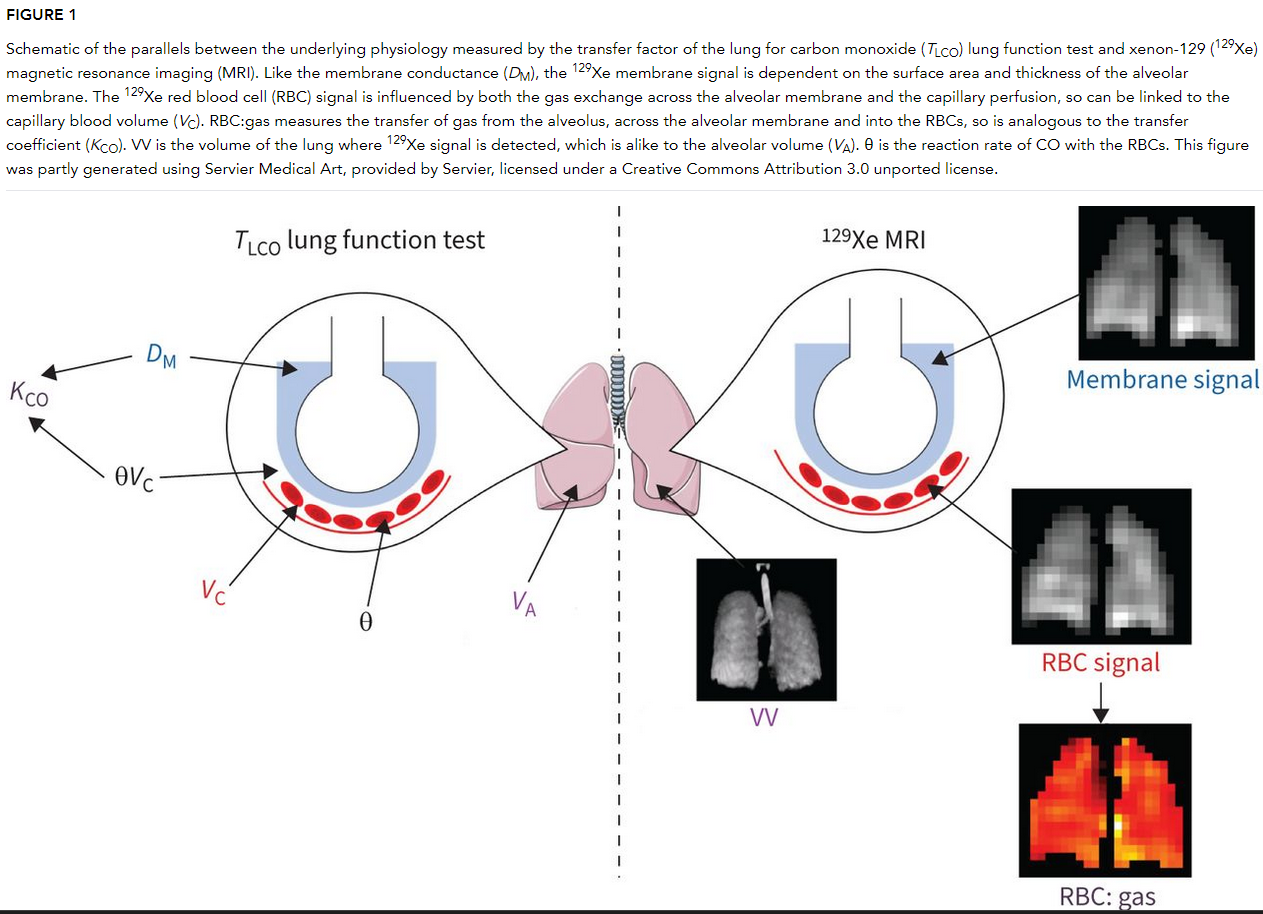
Pulmonary gas exchange is assessed by the transfer factor of the lungs (TL) for carbon monoxide (TLCO), and can also be measured with inhaled xenon-129 (129Xe) magnetic resonance imaging (MRI). A model has been proposed to estimate TL from 129Xe MRI metrics, but this approach has not been fully validated and does not utilise the spatial information provided by three-dimensional 129Xe MRI.
Methods
Three models for predicting TL from 129Xe MRI metrics were compared: 1) a previously-published physiology-based model, 2) multivariable linear regression and 3) random forest regression. Models were trained on data from 150 patients with asthma and/or COPD. The random forest model was applied voxel-wise to 129Xe images to yield regional TL maps.
Results
Coefficients of the physiological model were found to differ from previously reported values. All models had good prediction accuracy with small mean absolute error (MAE): 1) 1.24±0.15?mmol·min?1·kPa?1, 2) 1.01±0.06?mmol·min?1·kPa?1, 3) 0.995±0.129?mmol·min?1·kPa?1. The random forest model performed well when applied to a validation group of post-COVID-19 patients and healthy volunteers (MAE=0.840?mmol·min?1·kPa?1), suggesting good generalisability. The feasibility of producing regional maps of predicted TL was demonstrated and the whole-lung sum of the TL maps agreed with measured TLCO (MAE=1.18?mmol·min?1·kPa?1).
Conclusion
The best prediction of TLCO from 129Xe MRI metrics was with a random forest regression framework. Applying this model on a voxel-wise level to create parametric TL maps provides a useful tool for regional visualisation and clinical interpretation of 129Xe gas exchange MRI.