



Abstract
Background
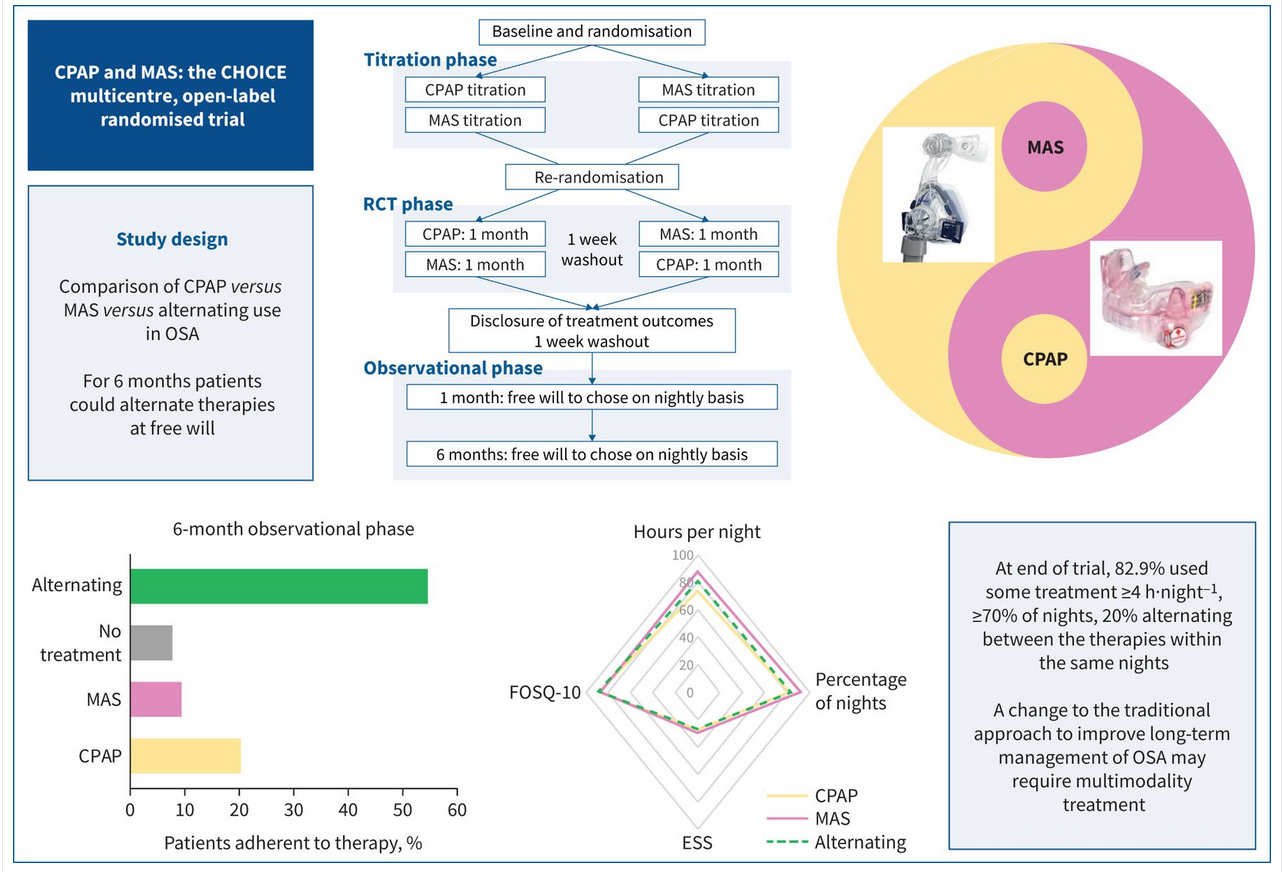
Adherence to continuous positive airway pressure (CPAP) for obstructive sleep apnoea (OSA) continues to be low with high termination rates. Alternative therapies to CPAP are needed. Our objective was to compare objective adherence to CPAP and mandibular advancement splints (MAS) and to evaluate their effectiveness, and additionally to identify treatment usage patterns and the clinical effectiveness of having both therapies.
Methods
This multicentre, double-randomised, three-phase trial (titration/crossover/observation) was conducted at three Canadian universities. Eligible participants were treatment-naïve with mild-to-severe OSA. The primary outcome was objectively measured adherence (hours per night) during the crossover phase. Secondary outcomes included efficacy during the crossover phase; adherence during the observational phase; and patient-centred outcomes, blood pressure and side-effects during the crossover and observational phases. Duration of the crossover and observational phase was 2.5 and 6?months, respectively.
Results
81 participants were enrolled in the first randomisation. 79 entered the adaptation/titration phase (mean±sd age 52.3±10.8?years; 58 males), 73 entered the crossover phase (included in the intention-to-treat analysis) and 64 completed the observational phase. Mean objective adherence over 1?month: MAS showed higher adherence than CPAP, 6.0 versus 5.3?h·night?1 (difference 0.7 (95% CI 0.3–1.2)?h·night?1; p<0.001). Mean CPAP?MAS difference in efficacy: 10.4 (95% CI 7.8–13.0)?events·h?1; p<0.001. During the observational phase 55% (35 out of 64) of participants chose to alternate therapies. All treatments led to substantial improvement in patient-centred outcomes.
Conclusions
Despite the higher efficacy of CPAP and higher adherence to MAS, both demonstrate comparable clinical effectiveness on patient-centred outcomes. Having both CPAP and MAS can improve long-term management of OSA.