



Abstract
Background
Placebo effects are common in studies of cough and antitussive medications, suggestive of a profound influence of brain activity over cough neural processing. We previously reported placebo intervention-associated reductions in the urge-to-cough and the associated higher order brain network activity evoked by capsaicin inhalation, an effect involving increased activation of the prefrontal cortex.
Objective
In this study, we set out to advance the understanding of placebo antitussive brain circuitry by testing the hypothesis that the activity of brainstem nuclei during capsaicin inhalation will similarly be altered by placebo intervention.
Methods
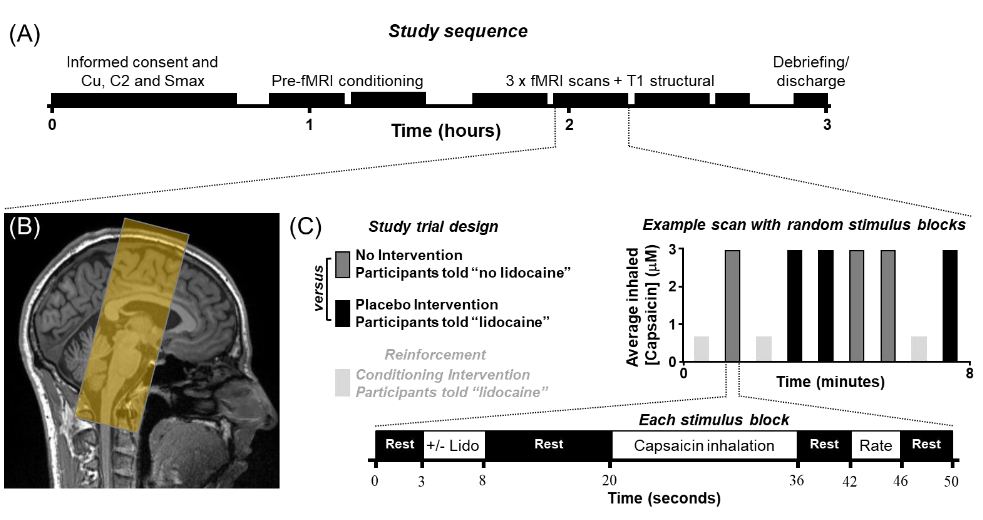
Using an expectation-dependent placebo induction design during blood oxygen level-dependent (BOLD) functional magnetic resonance imaging (fMRI) optimised for quantifying brainstem activity, we compared regional brainstem responses evoked by capsaicin inhalation in sixteen healthy individuals during No Intervention versus Placebo Intervention trials.
Results
Capsaicin-induced urge-to-cough subjective ratings were significantly lower during the Placebo Intervention trials than No Intervention trials. Placebo Intervention resulted in a significant reduction in capsaicin-induced BOLD signal activation across many brainstem nuclei including the medullary brainstem sites where airway vagal sensory neurons are known to terminate.
Conclusion
These data confirm the inhibitory effects of placebo intervention on capsaicin-evoked urge-to-cough and suggest the existence of a “top-down” brain circuit controlling cough sensory neural processing at the level of the brainstem during placebo conditions.