




Abstract
Background
The 6-min walk test (6MWT) provides an assessment of patient function and has been employed in interstitial lung disease clinical trials as an end-point. The ISABELA studies were two replicate randomised controlled trials of idiopathic pulmonary fibrosis (IPF) that included a regimented 6MWT protocol. The goal of this study was to combine 6MWT components into a pragmatic, easy to apply, composite clinical prediction score.
Methods
6MWT parameters associated with time to death or respiratory hospitalisation in the ISABELA studies were integrated into a single composite score. This score was then validated in an external cohort.
Results
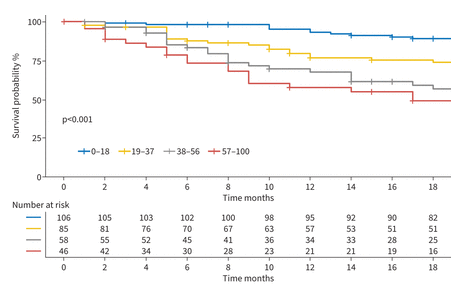
There were 1251 patients in the derivation set with 83 respiratory-related hospitalisations and 21 deaths observed after 48 weeks. After multivariable analysis, four parameters were independently predictive of outcomes: Borg dyspnoea score, oxygen flow rate, oxygen saturation nadir and the 6-min walk distance. A pragmatic model, termed the ODDS (oxygen, distance, dyspnoea, saturation) was then developed. This performed better than the individual parameters alone with an area under the curve (AUC) of 0.797, 0.781 and 0.766 for events at 12, 24 and 48 weeks, respectively. The ODDS model was similarly accurate when applied to the external validation set (n=295) at 48 weeks (AUC 0.758, 95% CI 0.688–0.825).
Conclusion
The 6MWT imparts important prognostic information which is best captured by combining constituent variables in a composite score system. The ODDS model might find utility in the clinical setting as well as in IPF studies where it can be used to risk-stratify patients for outcomes.